What we learned working with the Newsroom AI Lab’s first cohort
Plus, register for the AI x Journalism Summit in Baltimore, May 13-14

Slow Down First. That’s How Newsrooms Move Faster With AI.
Most newsrooms assume they need an army of engineers or a big tech budget to experiment with AI. They don't. What they need is a repeatable process, the right collaborators and time to understand their problems before reaching for tools, AI or otherwise.

That's one of the takeaways from the first cohort of our Newsroom AI Lab. We partnered with Wisconsin Watch and The Connecticut Mirror to guide their teams through the process of beginning not with technology, but with conversations, interviewing colleagues across roles to surface the friction in – and opportunities to expand – their daily work.
From there, they each picked one problem to solve. We kept the scope tight and the timeline short. The goal wasn't to showcase AI, but to see what would actually help.
Sign up for the AI x Journalism Summit (May 13–14)
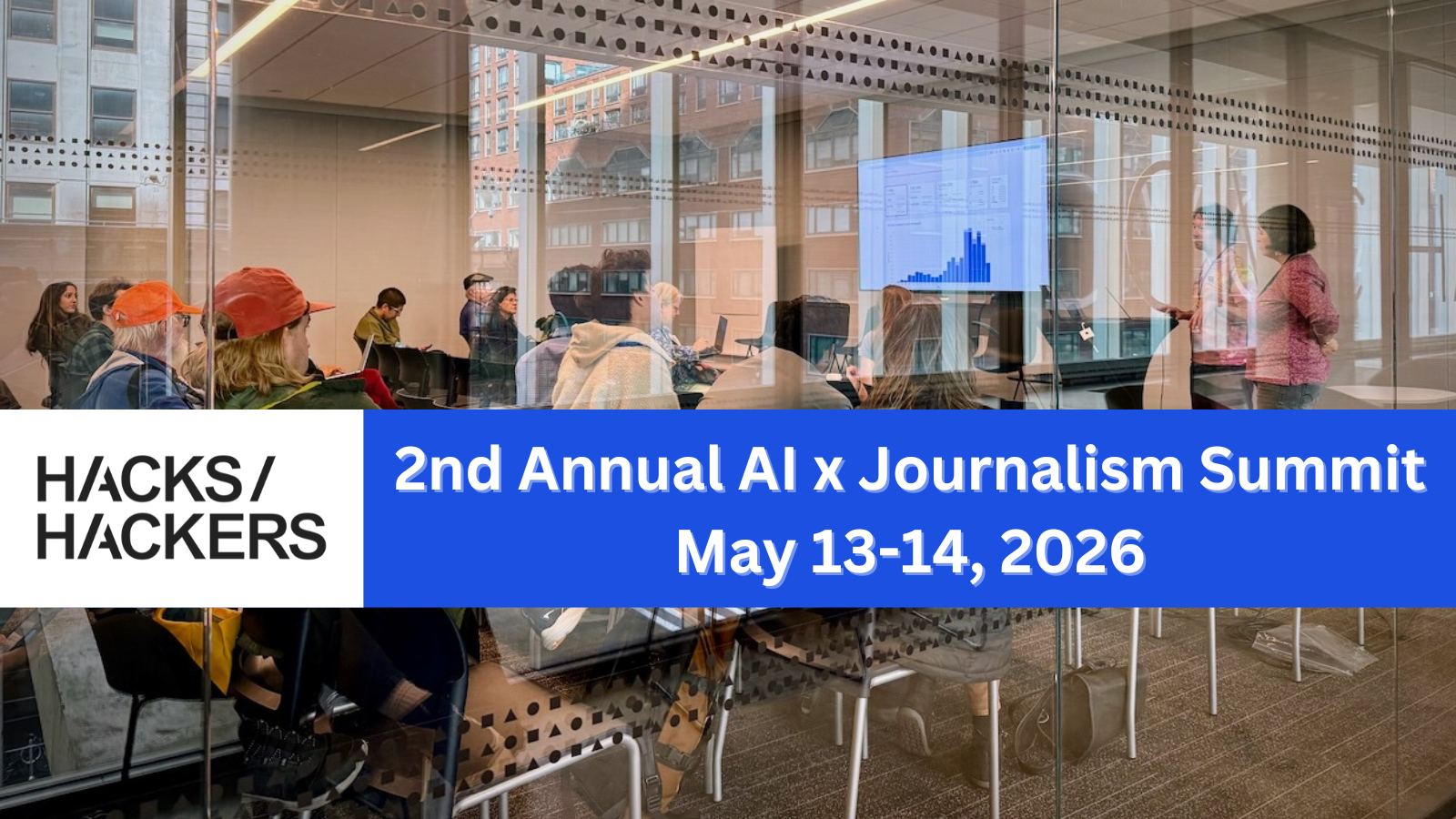
The Hacks/Hackers AI x Journalism Summit returns to Baltimore on May 13-14, 2026. Registration is now open and we hope you'll send us your pitches (use this submission form and see below for more details) for focused sessions and other programming at the summit led by experts who can go deep.
New research explores how "mental vaccine" social media posts can help people spot misinformation
RealityTeam, a non-profit working to push credible information into social media feeds that is fiscally sponsored by Hacks/Hackers, has a new article in Harvard Kennedy School Misinformation Review that examines whether short videos can help people spot manipulation online before they are fooled by it.
To address the problem of misinformation, the team tested prebunking as a potential "mental vaccine" – explaining common tricks used to mislead and misinform. In a real-world experiment, the team targeted a 19-second video ad to more than 375,000 Instagram users in the UK. Some users later saw a quiz asking them to identify a manipulative headline. Those who saw the video were about 21 percentage points better at spotting manipulation, and the effect lasted five months.
AI x journalism news
- 98.8% say AI can’t replace journalists. Why that matters now. (Editor & Publisher)
- Grok is an Epistemic Weapon (Tech Policy Press)
- Yann LeCun’s new venture is a contrarian bet against large language models (MIT Technology Review)
- Moltbot (Formerly Clawdbot) Showed Me What the Future of Personal AI Assistants Looks Like (Macstories)
Upcoming events
- Jan. 31, 2026, East Palo Alto, Building future AI news experiences with Hacks/Hackers, The Atlantic and Infactory
- Feb. 10–13, 2026, Miami, Knight Media Forum 2026
- Feb. 26–27, 2026, Orlando, Association of Community Publishers Conference & Trade Show 2026
- March 5–7, 2026, San Francisco, ACP Spring National College Media Conference 2026
- March 5–6, 2026, TBD, IIJ Freelance Conference 2026
- March 5–8, 2026, Indianapolis, NICAR26
Journalism jobs
- Assistant Professor Journalism - Digital & Interactive Storytelling, California Polytechnic State University, San Luis Obispo (US)
- Director of Communications and Marketing, Nasher Museum of Art, Duke University (US)
- Executive Director, Borderless Magazine NFP (US)
- Executive Director, Miller National Academy for Free Expression & Pluralism, University of Denver (US)
- Property and style news editor, WSJ (US)
- Reporter, FT's FundFire (US)
- Reuters is looking for 14 senior editors across the globe, Various Organizations (US)
- Senior Engagement Editor, Quanta Magazine, Simons Foundation (US)
- Tech reporter in San Francisco, Fortune (US)
- Curator of the Nieman Foundation for Journalism, Nieman Foundation for Journalism, Harvard University (Anywhere)
- Deputy Director of Investigations, The Sentry (Anywhere)
- Environment Journalist, Contexte (Anywhere)
- Fellowship Editor – Portuguese-Language, Mongabay (Anywhere)
- Forest Governance Media Initiative Project Director, Internews (Anywhere)
- Professor/Knight Chair in Journalism and Technology, University of Florida (Anywhere)
- Program Assistant, IREX (Anywhere)
- Project Officer, DW Akademie (Anywhere)
- Reporter, The Examination (Anywhere)
- Senior Analyst – OCCRP PRO, OCCRP (Anywhere)